Best Power Station for a Refrigerator
Product links currently go directly to merchants without affiliate tracking. EcoFriendlyGuide does not currently earn referral commissions from these links. How we choose products.
Updated October 5, 2026
Size the battery from your refrigerator’s measured energy use and the hours you need. Check compressor startup separately, then compare the source-checked candidates below.
Calculate your power needsCalculate your refrigerator power needs
Editable example from our existing fridge calculator: 150 W and 40% duty. Eight hours is an editorial planning example. Replace it with your measurements.
Editorial estimate: 628 Wh rated capacity. 500 to 1,200 Wh. Example runtime 13 hours.
Editorial size bands. Matches use 85% efficiency, 10% reserve and a 1.25 continuous-output margin. Confirm voltage, connectors and startup duration.
3 mathematical candidates. Startup not checked; confirm starting watts and connections.
BLUETTI Elite 100 V2
EcoFlow DELTA 3 Classic
Jackery Explorer 1000 v2
BLUETTI Elite 100 V2
EcoFlow DELTA 3 Classic
EcoFlow DELTA 3 Max
Jackery Explorer 1000 v2
Jackery HomePower 3000
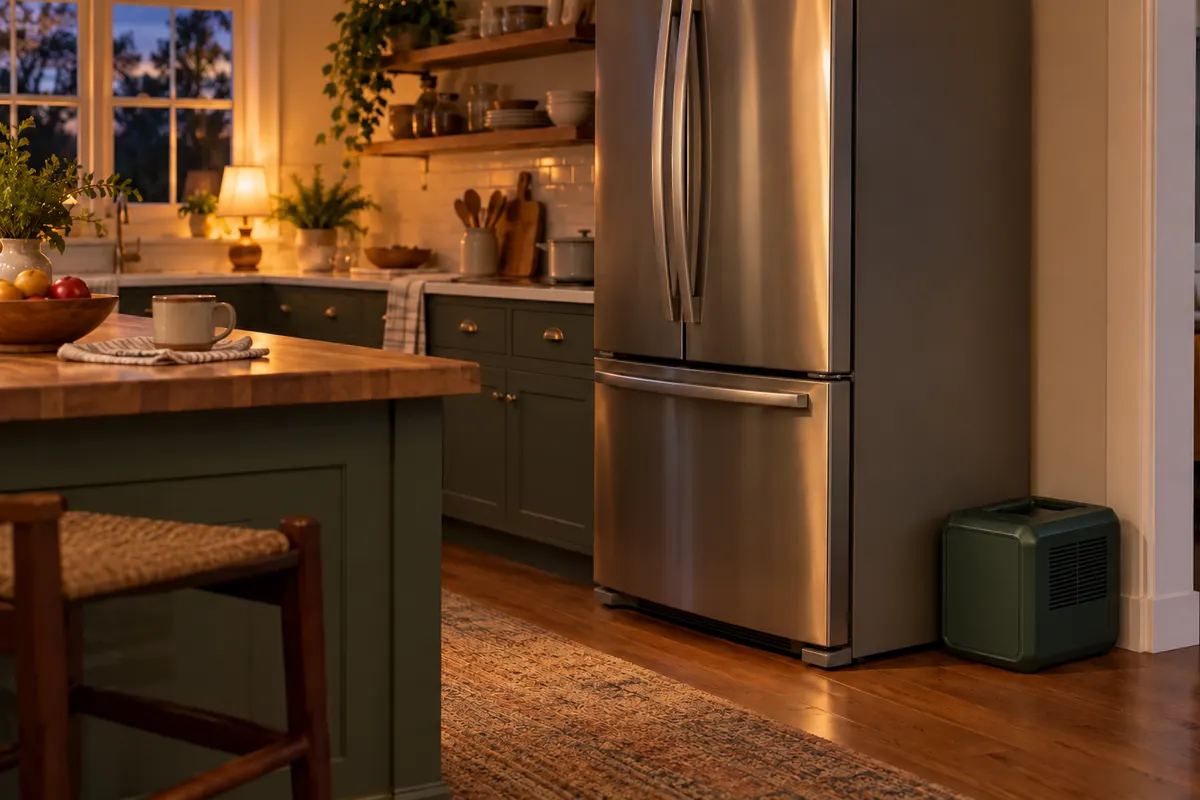
Shortlist by the tradeoff you care about
Lighter carrying option
Jackery Explorer 1000 v210.8 kg is the lowest listed mass in this shortlist. Output and startup still need checking.
Higher solar input in the compact shortlist
BLUETTI Elite 100 V2The verified solar input limit is 1,000 W. Actual harvest depends on panels and conditions.
More stored energy for longer plans
EcoFlow DELTA 3 Max2,048 rated Wh exceeds the compact candidates, with a 2,400 W continuous inverter.
Compare source-checked candidates
Evaluate these candidates against your appliance. Inclusion is not a compatibility guarantee.
| Model | Capacity (Wh) | Continuous / Surge (W) | Chemistry | Expansion | Solar input (W) | Weight (lb) | Est. runtime | Price | Buy |
|---|---|---|---|---|---|---|---|---|---|
| BLUETTI Elite 100 V2 | 1024Source checkedSourcesBLUETTI Elite 100 V2 US specificationsTech Specs for Elite 100 V2, not adjacent AC180 column. Surge is 3600 W; lifting power of 2700 W is not surge. | 1800Source checkedSourcesBLUETTI Elite 100 V2 US product and output informationTech Specs for Elite 100 V2, not adjacent AC180 column. Surge is 3600 W; lifting power of 2700 W is not surge. SourcesBLUETTI Elite 100 V2 US product and output informationTech Specs for Elite 100 V2, not adjacent AC180 column. Surge is 3600 W; lifting power of 2700 W is not surge. | LiFePO4Source checkedSourcesBLUETTI Elite 100 V2 US specificationsTech Specs for Elite 100 V2, not adjacent AC180 column. Surge is 3600 W; lifting power of 2700 W is not surge. | Not yet verified | 1000Source checkedSourcesBLUETTI Elite 100 V2 US specificationsTech Specs for Elite 100 V2, not adjacent AC180 column. Surge is 3600 W; lifting power of 2700 W is not surge. | 25.4Source checkedSourcesBLUETTI Elite 100 V2 US specificationsTech Specs for Elite 100 V2, not adjacent AC180 column. Surge is 3600 W; lifting power of 2700 W is not surge. | 13 hoursEditorial estimate | Check current price | |
| EcoFlow DELTA 3 Classic | 1024Source checkedSourcesEcoFlow DELTA 3 Classic US specificationsUS 120 V specification. Weight is nominal; source also prints +0.3 kg. X-Boost is not rated output. | 1800Source checkedSourcesEcoFlow DELTA 3 Classic US product and output informationUS 120 V specification. Weight is nominal; source also prints +0.3 kg. X-Boost is not rated output. SourcesEcoFlow DELTA 3 Classic US product and output informationUS 120 V specification. Weight is nominal; source also prints +0.3 kg. X-Boost is not rated output. | LiFePO4Source checkedSourcesEcoFlow DELTA 3 Classic US specificationsUS 120 V specification. Weight is nominal; source also prints +0.3 kg. X-Boost is not rated output. | Not yet verified | 500Source checkedSourcesEcoFlow DELTA 3 Classic US specificationsUS 120 V specification. Weight is nominal; source also prints +0.3 kg. X-Boost is not rated output. | 26.7Source checkedSourcesEcoFlow DELTA 3 Classic US specificationsUS 120 V specification. Weight is nominal; source also prints +0.3 kg. X-Boost is not rated output. | 13 hoursEditorial estimate | Check current price | |
| EcoFlow DELTA 3 Max | 2048Source checkedSourcesEcoFlow DELTA 3 Max US specificationsDELTA 3 Max, not Max Plus. Weight is nominal; source prints +0.4 kg. PV input is 500 W. Surge is 4800 W. | 2400Source checkedSourcesEcoFlow DELTA 3 Max US product and output informationDELTA 3 Max, not Max Plus. Weight is nominal; source prints +0.4 kg. PV input is 500 W. Surge is 4800 W. SourcesEcoFlow DELTA 3 Max US product and output informationDELTA 3 Max, not Max Plus. Weight is nominal; source prints +0.4 kg. PV input is 500 W. Surge is 4800 W. | LiFePO4Source checkedSourcesEcoFlow DELTA 3 Max US specificationsDELTA 3 Max, not Max Plus. Weight is nominal; source prints +0.4 kg. PV input is 500 W. Surge is 4800 W. | Not yet verified | 500Source checkedSourcesEcoFlow DELTA 3 Max US specificationsDELTA 3 Max, not Max Plus. Weight is nominal; source prints +0.4 kg. PV input is 500 W. Surge is 4800 W. | 44.8Source checkedSourcesEcoFlow DELTA 3 Max US specificationsDELTA 3 Max, not Max Plus. Weight is nominal; source prints +0.4 kg. PV input is 500 W. Surge is 4800 W. | 1d 2hEditorial estimate | Check current price | |
| Jackery Explorer 1000 v2 | 1070Source checkedSourcesJackery Explorer 1000 v2 US specificationsUS JE-1000D. Output and surge also checked against the US product page. | 1500Source checkedSourcesJackery Explorer 1000 v2 US product and output informationUS JE-1000D. Output and surge also checked against the US product page. SourcesJackery Explorer 1000 v2 US product and output informationUS JE-1000D. Output and surge also checked against the US product page. | LiFePO4Source checkedSourcesJackery Explorer 1000 v2 US specificationsUS JE-1000D. Output and surge also checked against the US product page. | Not yet verified | 400Source checkedSourcesJackery Explorer 1000 v2 US specificationsUS JE-1000D. Output and surge also checked against the US product page. | 23.8Source checkedSourcesJackery Explorer 1000 v2 US specificationsUS JE-1000D. Output and surge also checked against the US product page. | 14 hoursEditorial estimate | Check current price | |
| Jackery HomePower 3000 | 3072Source checkedSourcesJackery HomePower 3000 US specificationsHomePower 3000 unit specifications, not the SolarSaga panel specification. Merchant destination includes solar bundle variants; choose the correct unit or bundle at checkout. | 3600Source checkedSourcesJackery HomePower 3000 US product and output informationHomePower 3000 unit specifications, not the SolarSaga panel specification. Merchant destination includes solar bundle variants; choose the correct unit or bundle at checkout. SourcesJackery HomePower 3000 US product and output informationHomePower 3000 unit specifications, not the SolarSaga panel specification. Merchant destination includes solar bundle variants; choose the correct unit or bundle at checkout. | LiFePO4Source checkedSourcesJackery HomePower 3000 US specificationsHomePower 3000 unit specifications, not the SolarSaga panel specification. Merchant destination includes solar bundle variants; choose the correct unit or bundle at checkout. | Not yet verified | 1000Source checkedSourcesJackery HomePower 3000 US specificationsHomePower 3000 unit specifications, not the SolarSaga panel specification. Merchant destination includes solar bundle variants; choose the correct unit or bundle at checkout. | 59.5Source checkedSourcesJackery HomePower 3000 US specificationsHomePower 3000 unit specifications, not the SolarSaga panel specification. Merchant destination includes solar bundle variants; choose the correct unit or bundle at checkout. | 1d 15hEditorial estimate | Check current price |
How to choose a refrigerator battery without guessing
A refrigerator is a cycling load. The compressor may be idle when you first connect a meter, then start and run for a longer period when the kitchen warms or someone opens the door. Choosing a battery from that first idle reading can leave you short of energy. Choosing from the highest instantaneous reading alone can oversize the energy budget while still failing to answer the startup question. Keep the two measurements separate: energy over time for runtime, and the startup requirement for output.
There is no universal best battery for every fridge. The compact candidates above are worth examining when carrying weight and a modest backup window matter. The larger candidates store more energy but are heavier and may be harder to move from storage to the kitchen. First finish the load worksheet, then compare the tradeoffs. A product appearing in a table means its critical specifications were checked, not that we have operated your refrigerator from it.
1. Measure a complete cooling cycle
Use an appropriate plug-in energy meter if the refrigerator connection and meter ratings permit it. Record energy across normal compressor operation, idle periods and the way your household uses the appliance. Note the room conditions and whether the refrigerator was already cold. A period immediately after loading warm groceries can differ from an ordinary day. A defrost event can also change the load profile. Do not treat one short observation as a permanent specification for the appliance.
If your measurement is total Wh over a recorded interval, divide Wh by hours to obtain average W. Enter that average with duty cycle set to 100%. This is an Editorial estimate based on your observation. If you instead enter compressor running watts, you must supply the fraction of time it runs. Applying a duty cycle to an already averaged wattage would understate consumption. The calculator offers both paths through the same formula, but you must select inputs that belong together.
2. Investigate compressor startup separately
The motor can need a brief startup demand above its steady running load. Look for a manufacturer specification or ask the refrigerator supplier about the exact compressor and model. A basic meter may not capture a brief event correctly. An inverter’s published peak number does not describe every possible duration or load shape. Confirm that the power station manufacturer considers the starting behavior suitable for the intended connection.
The table distinguishes continuous output from surge. It does not substitute a power-boost marketing mode for either specification. If you leave startup watts blank, any calculator match is only an energy and steady-output candidate. That warning is especially relevant for a refrigerator because an inverter can have enough battery energy yet stop at each compressor start. Avoid buying on Wh alone, and do not repeatedly retry a setup that behaves abnormally.
3. Choose a useful backup window
Decide which gap you are trying to cover: a short interruption, an evening away from a charging source, or a longer event with planned recharge. The example at the top uses the site’s existing refrigerator illustration with an editable eight-hour target. It is not a claim about your appliance or typical utility restoration time. Replace the example values with measured consumption and the interval that matters to you.
Energy storage is finite. A longer target increases required capacity proportionally in this model, but real conditions can change during the interval. Consider a reserve for uncertain cycling and battery condition. Our default reserve is an editorial assumption that you can change. The conservative runtime applies an additional reduction to show sensitivity; it is still a calculation, not a minimum guaranteed service time.
4. Evaluate recharge as part of the purchase
Solar input W describes a maximum input limit, not the energy a panel will collect at your house. Panel voltage, connector compatibility, shading, season and available placement matter. During severe weather, the same conditions that cause an outage can prevent useful solar collection. Work out where approved panels and cables can be placed safely before treating solar as the solution to a long interruption.
AC charging can restore the battery when grid power returns, subject to the station’s input and outlet requirements. If you plan to recharge from a generator, follow the generator instructions and the carbon monoxide guidance in our battery versus gas generator guide. Never move an engine generator indoors to make charging convenient. Battery and generator arrangements are separate equipment decisions with different hazards.
5. Check where the battery will sit
Carrying mass matters when a battery must be lifted from a closet, carried upstairs or moved around kitchen furniture. The pounds in our table are converted from the manufacturer’s kg specification and rounded to one decimal. They exclude cables, panels and any extra batteries. Allow a stable location with the clearances and operating conditions required in the manual. Do not block cooling vents or put the station where spilled water can reach its connections.
Check cord routing as carefully as battery size. A route that keeps a refrigerator door from closing or creates a trip hazard is not a practical backup plan. Use properly rated equipment according to the appliance and station manuals. This page does not design household wiring. A portable unit should power the intended appliance through an approved connection, not feed electricity into a household wall outlet.
Full-size refrigerators, small fridges and freezers
Appliance labels describe storage arrangements, not a fixed electrical load. A chest freezer often stays closed during an outage, while a kitchen refrigerator may be opened repeatedly. A compact refrigerator may have a different compressor and insulation design. An upright freezer has its own defrost and door-opening behavior. Measure each exact unit rather than assigning a generic wattage from its size or name.
An annual energy label can be useful for a first planning calculation. Annual kWh multiplied by 1,000 and divided by 8,760 gives annual average W. Label that result as an Editorial estimate, use duty 100%, and remember that standardized annual conditions differ from your warm kitchen during a power outage. The annual average provides no compressor startup value. Our fridge runtime method explains how to keep these distinctions visible.
Temperature and usage change the estimate. A hotter room, warm food additions and frequent door opening can increase compressor operation. Keep a note of the conditions behind your measurement and rerun the calculator with a less favorable duty cycle to see how sensitive the result is. Do not present that alternative as a new measured specification. It is a planning scenario you control.
Food safety is a separate decision
A runtime calculator does not tell you whether food is safe. Read the linked FDA outage food-safety guidance, keep appliance doors closed when practical, and use the appropriate thermometer and food-handling recommendations. Do not rely on the battery display or on whether the compressor sounds normal to decide the condition of perishable food. Food temperature and outage history require their own assessment.
If the battery stops sooner than estimated, follow your food-safety plan instead of treating the estimate as a promise. Check the energy meter, battery condition and changed room conditions before relying on the same setup again. Preserve the distinction between a source-checked battery specification, an observation of your fridge and our mathematical result. That distinction is the reason this page includes the calculator, source links and limitations alongside the shortlist.
Frequently asked questions
Can a power station start my refrigerator?
Running watts alone cannot answer that. Check the compressor startup requirement, the inverter surge duration, voltage and connection requirements with both manufacturers.
How do I use an EnergyGuide label?
Annual kWh x 1000 / 8760 gives an annual average W. Use duty 100% with that averaged input. This is an Editorial estimate; it does not describe startup or a hot outage day.
Is a freezer the same load as a refrigerator?
No. Measure each appliance over its real cycle. Chest freezers, upright freezers and small refrigerators have different insulation, compressors and usage patterns.
Should I open the door to check food?
Follow the FDA outage guidance linked below. Keep doors closed when possible and use a thermometer and food safety guidance rather than a battery runtime estimate.
Does a larger battery guarantee a longer outage plan?
It stores more rated energy, but the plan also needs adequate output, a realistic reserve, safe wiring and a recharge path. More Wh does not establish appliance compatibility.
How we calculate and choose
These products are not hands-on tested by EcoFriendlyGuide. Tables report manufacturer specifications checked against linked United States sources. Rated capacity is not measured usable energy. Runtime is an Editorial estimate: rated Wh x 0.85 efficiency x (1 - 10% reserve) / (running W x duty). The conservative result applies another 0.85 factor. These assumptions are editable, not promises.
Sizing reverses that formula. Matching requires enough usable energy for your chosen hours, continuous AC output at least 1.25 times running load, and sufficient published surge when you supply startup watts. The 1.25 margin and Editorial size bands are editorial assumptions, not industry standards. Voltage, connections and surge duration need separate confirmation. An unknown startup load cannot establish motor compatibility.
Only current models with six source-checked critical fields and verification within 90 days enter our comparisons. Read the full research methodology.
Sources
- BLUETTI Elite 100 V2 US product and output information (BLUETTI; checked 2026-10-05)
- BLUETTI Elite 100 V2 US specifications (BLUETTI; checked 2026-10-05)
- EcoFlow DELTA 3 Classic US product and output information (EcoFlow; checked 2026-10-05)
- EcoFlow DELTA 3 Classic US specifications (EcoFlow; checked 2026-10-05)
- EcoFlow DELTA 3 Max US product and output information (EcoFlow; checked 2026-10-05)
- EcoFlow DELTA 3 Max US specifications (EcoFlow; checked 2026-10-05)
- Scenario calculator example assumptions (EcoFriendlyGuide; checked 2026-10-05)
- Food and Water Safety During Power Outages and Floods (U.S. Food and Drug Administration; checked 2026-07-30)
- Jackery Explorer 1000 v2 US product and output information (Jackery; checked 2026-10-05)
- Jackery Explorer 1000 v2 US specifications (Jackery; checked 2026-10-05)
- Jackery HomePower 3000 US product and output information (Jackery; checked 2026-10-05)
- Jackery HomePower 3000 US specifications (Jackery; checked 2026-10-05)