Best Power Station for RV and Camping
Product links currently go directly to merchants without affiliate tracking. EcoFriendlyGuide does not currently earn referral commissions from these links. How we choose products.
Updated October 5, 2026
Separate campsite essentials from RV air conditioning. Size daily energy first, then verify the motor startup requirement, RV inlet connection and the charging plan for your route.
Calculate your power needsCalculate your rv camping loads power needs
Enter your own camping loads and target hours. For RV air conditioning, use the dedicated example input section and the air-conditioner manufacturer’s startup data.
Enter running watts, duty cycle and target hours to calculate capacity and runtime. Not yet verified for your appliance.
Editorial size bands. Matches use 85% efficiency, 10% reserve and a 1.25 continuous-output margin. Confirm voltage, connectors and startup duration.
Matches appear after you enter your load.
BLUETTI Elite 100 V2
EcoFlow DELTA 3 Classic
EcoFlow DELTA 3 Max
Jackery Explorer 1000 v2
Jackery HomePower 3000
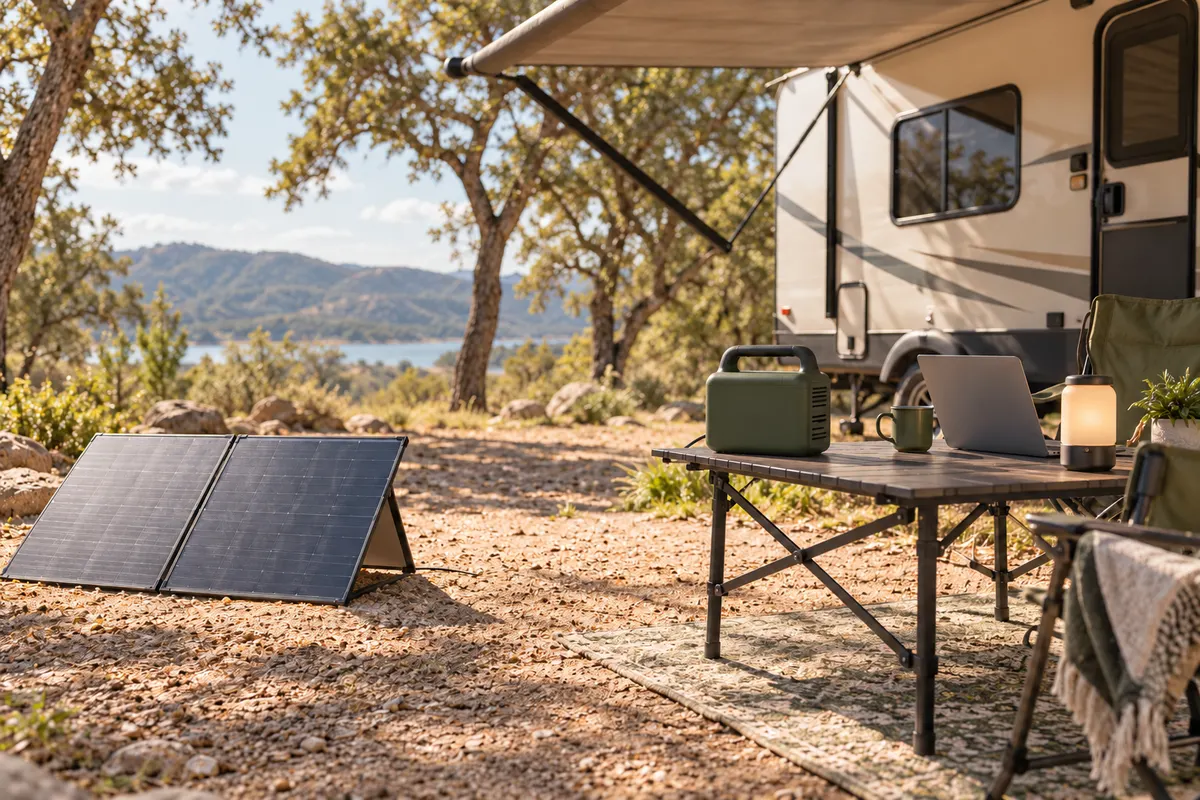
Estimate solar replenishment days
Enter panel watts, effective peak sun hours per day and your own yield factor. No location-specific sunlight or charging efficiency is assumed. This idealized estimate excludes energy used while charging.
Daily Wh = panel W x peak sun hours x yield factor. Days = energy to replenish / daily Wh. Verify the station's solar input limit, panel voltage, connectors and real charging performance.
Shortlist by the tradeoff you care about
Lighter carrying option
Jackery Explorer 1000 v210.8 kg is the lowest listed mass in this shortlist. Output and startup still need checking.
Higher solar input in the compact shortlist
BLUETTI Elite 100 V2The verified solar input limit is 1,000 W. Actual harvest depends on panels and conditions.
More stored energy for longer plans
EcoFlow DELTA 3 Max2,048 rated Wh exceeds the compact candidates, with a 2,400 W continuous inverter.
Compare source-checked candidates
Evaluate these candidates against your appliance. Inclusion is not a compatibility guarantee.
| Model | Capacity (Wh) | Continuous / Surge (W) | Chemistry | Expansion | Solar input (W) | Weight (lb) | Est. runtime | Price | Buy |
|---|---|---|---|---|---|---|---|---|---|
| BLUETTI Elite 100 V2 | 1024Source checkedSourcesBLUETTI Elite 100 V2 US specificationsTech Specs for Elite 100 V2, not adjacent AC180 column. Surge is 3600 W; lifting power of 2700 W is not surge. | 1800Source checkedSourcesBLUETTI Elite 100 V2 US product and output informationTech Specs for Elite 100 V2, not adjacent AC180 column. Surge is 3600 W; lifting power of 2700 W is not surge. SourcesBLUETTI Elite 100 V2 US product and output informationTech Specs for Elite 100 V2, not adjacent AC180 column. Surge is 3600 W; lifting power of 2700 W is not surge. | LiFePO4Source checkedSourcesBLUETTI Elite 100 V2 US specificationsTech Specs for Elite 100 V2, not adjacent AC180 column. Surge is 3600 W; lifting power of 2700 W is not surge. | Not yet verified | 1000Source checkedSourcesBLUETTI Elite 100 V2 US specificationsTech Specs for Elite 100 V2, not adjacent AC180 column. Surge is 3600 W; lifting power of 2700 W is not surge. | 25.4Source checkedSourcesBLUETTI Elite 100 V2 US specificationsTech Specs for Elite 100 V2, not adjacent AC180 column. Surge is 3600 W; lifting power of 2700 W is not surge. | Enter your load in the calculatorEditorial estimate | Check current price | |
| EcoFlow DELTA 3 Classic | 1024Source checkedSourcesEcoFlow DELTA 3 Classic US specificationsUS 120 V specification. Weight is nominal; source also prints +0.3 kg. X-Boost is not rated output. | 1800Source checkedSourcesEcoFlow DELTA 3 Classic US product and output informationUS 120 V specification. Weight is nominal; source also prints +0.3 kg. X-Boost is not rated output. SourcesEcoFlow DELTA 3 Classic US product and output informationUS 120 V specification. Weight is nominal; source also prints +0.3 kg. X-Boost is not rated output. | LiFePO4Source checkedSourcesEcoFlow DELTA 3 Classic US specificationsUS 120 V specification. Weight is nominal; source also prints +0.3 kg. X-Boost is not rated output. | Not yet verified | 500Source checkedSourcesEcoFlow DELTA 3 Classic US specificationsUS 120 V specification. Weight is nominal; source also prints +0.3 kg. X-Boost is not rated output. | 26.7Source checkedSourcesEcoFlow DELTA 3 Classic US specificationsUS 120 V specification. Weight is nominal; source also prints +0.3 kg. X-Boost is not rated output. | Enter your load in the calculatorEditorial estimate | Check current price | |
| EcoFlow DELTA 3 Max | 2048Source checkedSourcesEcoFlow DELTA 3 Max US specificationsDELTA 3 Max, not Max Plus. Weight is nominal; source prints +0.4 kg. PV input is 500 W. Surge is 4800 W. | 2400Source checkedSourcesEcoFlow DELTA 3 Max US product and output informationDELTA 3 Max, not Max Plus. Weight is nominal; source prints +0.4 kg. PV input is 500 W. Surge is 4800 W. SourcesEcoFlow DELTA 3 Max US product and output informationDELTA 3 Max, not Max Plus. Weight is nominal; source prints +0.4 kg. PV input is 500 W. Surge is 4800 W. | LiFePO4Source checkedSourcesEcoFlow DELTA 3 Max US specificationsDELTA 3 Max, not Max Plus. Weight is nominal; source prints +0.4 kg. PV input is 500 W. Surge is 4800 W. | Not yet verified | 500Source checkedSourcesEcoFlow DELTA 3 Max US specificationsDELTA 3 Max, not Max Plus. Weight is nominal; source prints +0.4 kg. PV input is 500 W. Surge is 4800 W. | 44.8Source checkedSourcesEcoFlow DELTA 3 Max US specificationsDELTA 3 Max, not Max Plus. Weight is nominal; source prints +0.4 kg. PV input is 500 W. Surge is 4800 W. | Enter your load in the calculatorEditorial estimate | Check current price | |
| Jackery Explorer 1000 v2 | 1070Source checkedSourcesJackery Explorer 1000 v2 US specificationsUS JE-1000D. Output and surge also checked against the US product page. | 1500Source checkedSourcesJackery Explorer 1000 v2 US product and output informationUS JE-1000D. Output and surge also checked against the US product page. SourcesJackery Explorer 1000 v2 US product and output informationUS JE-1000D. Output and surge also checked against the US product page. | LiFePO4Source checkedSourcesJackery Explorer 1000 v2 US specificationsUS JE-1000D. Output and surge also checked against the US product page. | Not yet verified | 400Source checkedSourcesJackery Explorer 1000 v2 US specificationsUS JE-1000D. Output and surge also checked against the US product page. | 23.8Source checkedSourcesJackery Explorer 1000 v2 US specificationsUS JE-1000D. Output and surge also checked against the US product page. | Enter your load in the calculatorEditorial estimate | Check current price | |
| Jackery HomePower 3000 | 3072Source checkedSourcesJackery HomePower 3000 US specificationsHomePower 3000 unit specifications, not the SolarSaga panel specification. Merchant destination includes solar bundle variants; choose the correct unit or bundle at checkout. | 3600Source checkedSourcesJackery HomePower 3000 US product and output informationHomePower 3000 unit specifications, not the SolarSaga panel specification. Merchant destination includes solar bundle variants; choose the correct unit or bundle at checkout. SourcesJackery HomePower 3000 US product and output informationHomePower 3000 unit specifications, not the SolarSaga panel specification. Merchant destination includes solar bundle variants; choose the correct unit or bundle at checkout. | LiFePO4Source checkedSourcesJackery HomePower 3000 US specificationsHomePower 3000 unit specifications, not the SolarSaga panel specification. Merchant destination includes solar bundle variants; choose the correct unit or bundle at checkout. | Not yet verified | 1000Source checkedSourcesJackery HomePower 3000 US specificationsHomePower 3000 unit specifications, not the SolarSaga panel specification. Merchant destination includes solar bundle variants; choose the correct unit or bundle at checkout. | 59.5Source checkedSourcesJackery HomePower 3000 US specificationsHomePower 3000 unit specifications, not the SolarSaga panel specification. Merchant destination includes solar bundle variants; choose the correct unit or bundle at checkout. | Enter your load in the calculatorEditorial estimate | Check current price |
Build a campsite energy budget before choosing a battery
Camping combines equipment that behaves very differently. A light may run steadily in the evening, a compressor refrigerator cycles through the day, and a coffee-making appliance can draw substantial power for a short task. RV air conditioning introduces a motor-start question and a potentially demanding cooling schedule. Treating all of these as one generic camping wattage makes the battery choice less useful. List the actual tasks and separate steady energy needs from occasional high-output tasks.
Decide whether the station will sit beside individual appliances or connect through an approved RV inlet arrangement. Those use cases require different equipment checks. A portable station with a convenient outlet cannot automatically supply every circuit or voltage arrangement in a vehicle. Its energy and output specifications are only the beginning of the compatibility review. The shortlist above provides verified US unit data and keeps unverified features visible.
1. Record a daily schedule, not just device names
Start with the equipment you will bring and the duration of each task. Use measured or documented demand for the exact device. Consider refrigeration, communications, lighting, work equipment and water-system accessories if relevant. A gas appliance may still require an electrical control or fan, and that demand belongs in the worksheet when it is documented. Do not assume that a familiar campsite item has the same power use as one owned by another traveler.
Calculate task energy as W multiplied by operating hours, using duty cycle when a load genuinely cycles. For already averaged W, enter duty 100%. Add task energy for the day, then choose how many days must be covered before a reliable recharge opportunity. Also check which devices can run simultaneously. A low daily Wh total can coexist with a brief output demand that exceeds a compact inverter.
2. Choose carrying weight and storage space deliberately
The manufacturer’s unit mass is converted to lb in the table so you can compare carrying requirements. Panels, cables, adapters and any extra batteries add weight and occupy space. Think about who will move the unit, the height of the storage compartment and whether it must be unloaded at every stop. A battery that is easy to roll on pavement may be awkward on uneven ground or at a campsite with steps.
Follow the vehicle and equipment instructions for securing the station in transit. Protect ports and cables from loose cargo, and keep ventilation clear when operating. Heat in a closed vehicle, moisture at a campsite and unstable placement require their own precautions. Do not assume a battery or panel weather-resistance claim applies to exposed plugs, adapters or the entire setup.
3. Compare solar input with the panels you can deploy
Solar input is a limit for the station, not a measurement of your campsite’s sun. Verify panel open-circuit voltage, current, connectors and permitted series or parallel arrangements against the exact station manual. A panel family advertised alongside a product may include several options. Confirm the bundle you intend to buy instead of assuming the largest advertised array is included.
Shade from trees, neighboring vehicles and the RV itself can affect collection through the day. Consider where panels can be placed without blocking access or creating a cable hazard. Portable panels may need repositioning; permanently mounted equipment has different installation questions. Obtain manufacturer or qualified installer guidance rather than designing a wiring arrangement from the solar W column alone.
4. Estimate harvest with inputs from your location
You can build an idealized solar worksheet from panel nameplate W multiplied by equivalent full-sun hours. Supply the sunlight assumption yourself from an appropriate location-specific source or your own documented observations. Do not confuse daylight duration with full-power production. Nameplate W x sun hours gives idealized Wh before charging and environmental losses, so label the calculation as an Editorial estimate.
Compare that harvest with the day’s load energy. If expected harvest is smaller, storage will decline over successive days even when the first day’s battery appears adequate. If harvest is larger under a sunny example, still plan a cloudy or shaded alternative. There is no sourced sunlight preset on this page. A route, season and campsite all matter more than a generic number of sunny hours.
5. Confirm the charging opportunities on your route
Shore power can provide a recharge opportunity, subject to campsite and equipment requirements. A vehicle charging plan needs manufacturer-approved hardware and an understanding of its input limit. Do not assume an ordinary accessory socket will recharge a large battery quickly, or invent a charge duration from the battery name alone. Check the approved system and the time you will actually be driving or parked with available power.
An engine generator is another separate equipment decision. Follow site rules, generator instructions and the CDC carbon monoxide guidance linked through our generator comparison. Keep exhaust hazards distinct from battery operation. A campground restriction on engines or an unavailable fuel supply can change the recharge plan even if the battery itself works normally.
RV air conditioning requires a separate startup screen
Use the dedicated calculator section below for your air conditioner rather than a general campsite average. Obtain the unit’s running demand and its documented starting or locked-rotor characteristics. If the manufacturer provides amperes, ask how to interpret the requirement for an inverter; multiplying current by voltage may describe apparent power rather than real W. A compressor’s starting event also has a duration that a simple peak-W comparison does not capture.
A soft starter can change the startup profile when approved and installed for the equipment. It does not create extra battery energy, and it does not justify a guessed reduction percentage. Use the manufacturer’s documented result for your exact air conditioner and installation. After startup has been addressed, estimate cooling energy from actual cycling and the time you plan to operate. Hot weather can change that schedule materially.
A 30A or 50A label describes a connection interface, not a promise of station output. Check voltage, circuit distribution, adapters, grounding and protection with the equipment manuals and a qualified RV professional. Do not improvise a connection to make a plug fit. The presence of a familiar receptacle is insufficient to determine that every vehicle circuit can be supplied as intended.
The larger candidates in this comparison store more energy than the compact models and publish higher continuous output. Those are specification differences, not proof of air-conditioner compatibility or all-night cooling. Leave startup unknown until the correct data is available, and treat any energy-only match as incomplete. If the catalog has no sufficient candidate, investigate the approved system requirements instead of reducing the demand to obtain a convenient result.
Boondocking over several days
Off-grid stays make the daily balance between consumption and recharge more important than the initial full charge. Keep track of actual energy used and collected, and review the plan when weather, parking shade or appliance schedules change. A larger battery can bridge a deficit for longer, but it does not turn a persistent energy deficit into a sustainable arrangement.
Set priorities before reaching a low state of charge. Decide which optional tasks can be postponed and which require an independent approved backup plan. Medical equipment needs guidance from the clinician and equipment supplier; use our CPAP power planning page only as an electrical worksheet. Avoid letting discretionary cooling or entertainment silently consume energy reserved for another purpose.
When you return from a trip, retain the measured inputs and compare them with the estimates. Update future plans using documented observations, while keeping those observations distinct from manufacturer specifications. Our camping and RV hub connects sizing, charging and safety research. The best result from this guide is a practical load schedule, a verified connection arrangement and a recharge fallback suited to your journey.
RV air conditioner: calculate a separate load
No generic starting watts are supplied. Enter your manufacturer's running power, starting load and observed cycling. This blank example must be completed before it can screen candidates.
Calculate your rv air conditioner power needs
User-entered RV AC example; no assumed motor ratings.
Enter running watts, duty cycle and target hours to calculate capacity and runtime. Not yet verified for your appliance.
Editorial size bands. Matches use 85% efficiency, 10% reserve and a 1.25 continuous-output margin. Confirm voltage, connectors and startup duration.
Matches appear after you enter your load.
BLUETTI Elite 100 V2
EcoFlow DELTA 3 Classic
EcoFlow DELTA 3 Max
Jackery Explorer 1000 v2
Jackery HomePower 3000
Frequently asked questions
Can a station run my RV air conditioner?
Confirm actual running demand, locked-rotor or starting requirements, voltage and the connection arrangement. A general Wh rating cannot establish startup or useful cooling time.
Does a soft starter solve everything?
A manufacturer-approved soft starter can alter the startup profile. Use the documented result for your unit; do not apply a guessed reduction percentage.
Does a 30A or 50A connection equal output capacity?
An inlet or plug rating describes an interface. Battery inverter output, available voltage, circuit distribution and adapter limitations must all be checked separately.
How much solar will I collect?
Enter actual panel watts and equivalent full-sun hours for your location. Nameplate W x sun hours is only an idealized energy calculation; shading, heat and conversion reduce harvest.
What changes when boondocking for several days?
Daily consumption, actual solar harvest and battery reserve must balance. Plan the drive, generator or shore-power recharge option when weather or shade prevents that balance.
How we calculate and choose
These products are not hands-on tested by EcoFriendlyGuide. Tables report manufacturer specifications checked against linked United States sources. Rated capacity is not measured usable energy. Runtime is an Editorial estimate: rated Wh x 0.85 efficiency x (1 - 10% reserve) / (running W x duty). The conservative result applies another 0.85 factor. These assumptions are editable, not promises.
Sizing reverses that formula. Matching requires enough usable energy for your chosen hours, continuous AC output at least 1.25 times running load, and sufficient published surge when you supply startup watts. The 1.25 margin and Editorial size bands are editorial assumptions, not industry standards. Voltage, connections and surge duration need separate confirmation. An unknown startup load cannot establish motor compatibility.
Only current models with six source-checked critical fields and verification within 90 days enter our comparisons. Read the full research methodology.
Sources
- BLUETTI Elite 100 V2 US product and output information (BLUETTI; checked 2026-10-05)
- BLUETTI Elite 100 V2 US specifications (BLUETTI; checked 2026-10-05)
- Generator Safety Fact Sheet (Centers for Disease Control and Prevention; checked 2026-07-30)
- EcoFlow DELTA 3 Classic US product and output information (EcoFlow; checked 2026-10-05)
- EcoFlow DELTA 3 Classic US specifications (EcoFlow; checked 2026-10-05)
- EcoFlow DELTA 3 Max US product and output information (EcoFlow; checked 2026-10-05)
- EcoFlow DELTA 3 Max US specifications (EcoFlow; checked 2026-10-05)
- Scenario calculator example assumptions (EcoFriendlyGuide; checked 2026-10-05)
- Jackery Explorer 1000 v2 US product and output information (Jackery; checked 2026-10-05)
- Jackery Explorer 1000 v2 US specifications (Jackery; checked 2026-10-05)
- Jackery HomePower 3000 US product and output information (Jackery; checked 2026-10-05)
- Jackery HomePower 3000 US specifications (Jackery; checked 2026-10-05)